When Client Strategy Becomes Enterprise Strategy

Serving many institutional clients well depends on one capability: converting what clients tell you into enterprise decisions you can fund, own and deliver. That is where client strategy becomes enterprise strategy.
The question behind this piece
Each institutional client brings its own mandate, context and definition of value. The enterprise has one set of resources, one operating plan and one roadmap. Insight about what clients want is usually abundant, gathered through executive discussions, reviews, account plans and daily service. Converting that insight into enterprise decisions is where the work concentrates. How should a multi-client organization turn competing client priorities into one coherent enterprise strategy?
Why this matters now
Institutional clients increasingly expect their priorities to shape product, service, technology and operating decisions, beyond the quality of the relationship itself. In most organizations the insight already exists. It simply sits scattered across relationship teams, business units, product and delivery, with no shared mechanism to compare competing priorities, weigh them and fund them.
The result is a predictable gap. Clients believe their priorities were heard. Internal teams keep working the roadmap they already had. Commitments accumulate faster than capacity. Dates slip. The relationship leader is left explaining decisions they did not make against timelines they do not control.
What looks like a client-management problem is often an enterprise-planning problem.
Our perspective
Client relationships create strategic value only when they change enterprise choices. That requires an explicit translation layer between what clients ask for and what the organization decides to build, change, sequence or stop.
The first move is to stop seeing clients as separate accounts and start seeing them as one system. Which outcomes create the most value. Which priorities repeat across clients. Where different requests point to the same underlying capability. Where commitments already compete for the same people and budget. Without that view every request looks equally urgent, and urgency sets the agenda.
The second move is to translate requests into capabilities. Clients describe needs in the language of their own experience. One asks for a report, one for stronger controls, one for faster processing. Those can sound unrelated while pointing to the same need. The task is to find the common capability beneath them and decide whether it belongs in the shared platform or remains a differentiated requirement with explicit economics, ownership and delivery implications.
To keep that honest, four tests decide what earns the roadmap.
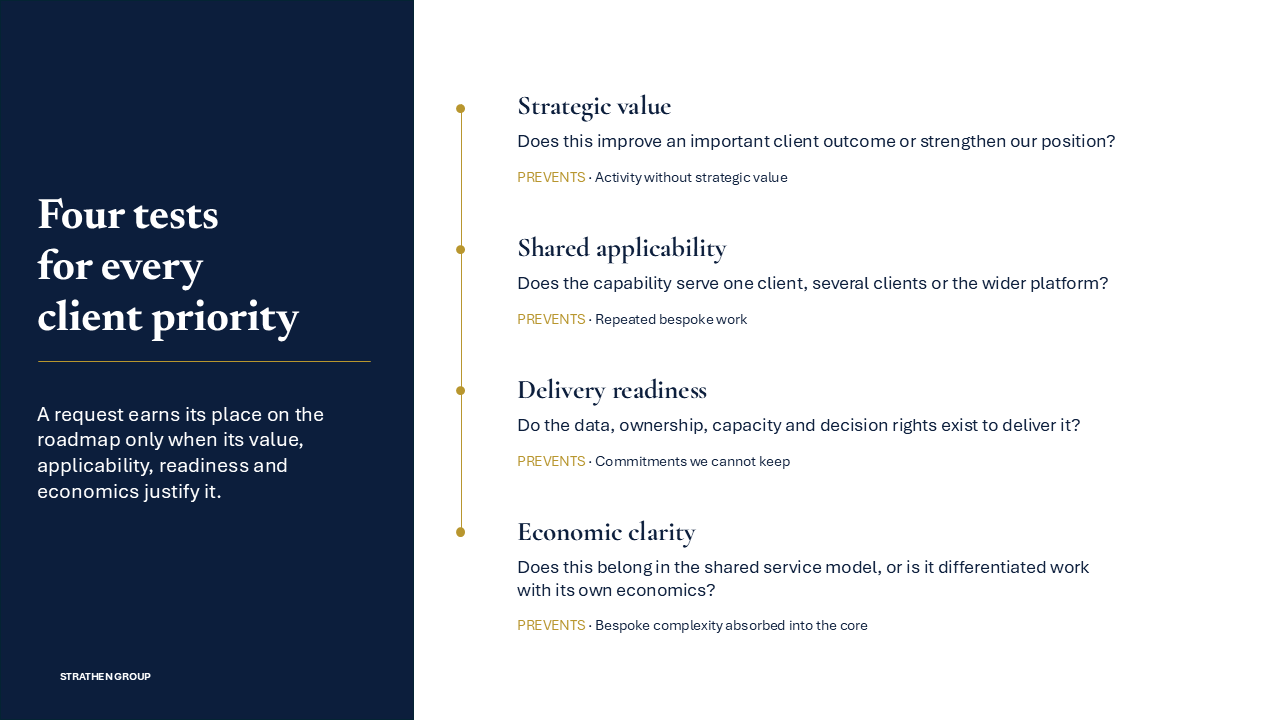
A request should enter because its value, applicability, readiness and economics justify it, not because an important client raised it.
Discipline has a cost worth naming. Applied clumsily it feels like bureaucracy to a client who wanted a fast yes, and a set of tests can become the reason nothing ships. So the work cannot end at a filter. It has to end at a decision with a named owner and a clear next date, returned to the client with the reasoning attached. Clients do not expect every request to get a yes. They expect to see that their priority entered a real decision process rather than disappearing into meeting notes. Give them that and the answer can be no, not yet or a differentiated arrangement, and the relationship holds.
The stakes rise when volume arrives at once. Consider an institution that has just absorbed a client portfolio through acquisition. Overnight it serves several client groups with different journeys, controls and priorities competing for finite delivery capacity. Handle each as an isolated build and you inherit duplication, platform complexity and colliding commitments. Separate the common core from the differentiated edge and you get a platform built once and a relationship that stays honest about what is shared and what is not.
The strongest client relationships are not built by saying yes to everything. They are built by showing clients where the line sits and how the call was made.
How we help
Strathen Group works with multi-client organizations to strengthen how client insight becomes enterprise decisions. We map the client system to separate shared priorities from differentiated ones, set consistent tests for what earns the roadmap, connect priorities to capacity and ownership, then build reporting that closes the loop between what was promised and what was delivered. The work can start as a single executive session, run as a focused diagnostic sprint or extend into a broader decision-to-delivery engagement.