M&A diligence that tests value drivers and integration readiness

Many diligence processes confirm the story instead of testing it. Leaders need a structured way to validate value drivers, surface execution constraints, and identify integration readiness gaps before they become surprises.
The question behind this piece
In many deals, the narrative is compelling and the model is clean, but the decision still hinges on one question: can the value drivers actually be executed under real constraints? Too often, diligence validates what is already believed, then integration begins with a long list of “to be determined” items. How do you run diligence that pressure-tests the value drivers and produces an integration readiness view leaders can act on immediately?
Why this matters now
Deal tolerance for execution risk has tightened. Buyers still pursue strategic assets, but they are less forgiving about hidden operational fragility: dependence on a few people, weak data, brittle systems, informal processes, or concentration risks that are not fully understood.
Integration complexity has also increased. Many targets run on layered tools, distributed teams, and partner ecosystems. If the integration plan is not grounded, the deal can lose months to stabilisation, and the value-creation timeline slips. Old approaches fail because they separate commercial diligence from operating reality. The value drivers are operational. If you cannot run them, you cannot underwrite them.
If the value driver cannot be executed in week one, it is not yet a value driver. It is an assumption.
Our perspective
Effective diligence has a different goal: not to confirm the story, but to convert the story into a set of tested drivers with clear execution paths and known risks. We recommend a lens built around four questions.
I. What are the 3–5 value drivers, and how exactly do they work?
Force specificity. Most models include generic levers: pricing, cross-sell, growth efficiency, cost reduction, and operating leverage. Diligence should translate each into a mechanism: what changes, where it changes, who makes the change, and what must be true for it to hold. “Pricing uplift” is not a driver unless you can answer segment, product, price architecture, sales motion, churn sensitivity, and competitive response. “Synergies” are not a driver unless you can explain which workflows and systems will combine, and what breaks when they do.
II. What constraints will block execution, and can we remove them?
This is where diligence often underperforms. Surface constraints across talent bandwidth, process maturity, systems limitations, data quality, vendor lock-in, and customer or regulatory constraints. The goal is not to find problems. The goal is to determine whether constraints are removable inside the value-creation timeline. A simple pattern works: driver, constraints, prerequisites, and time-to-first-proof. If prerequisites are heavy, the model and timeline should reflect reality.
III. What is integration readiness, and where are the gaps?
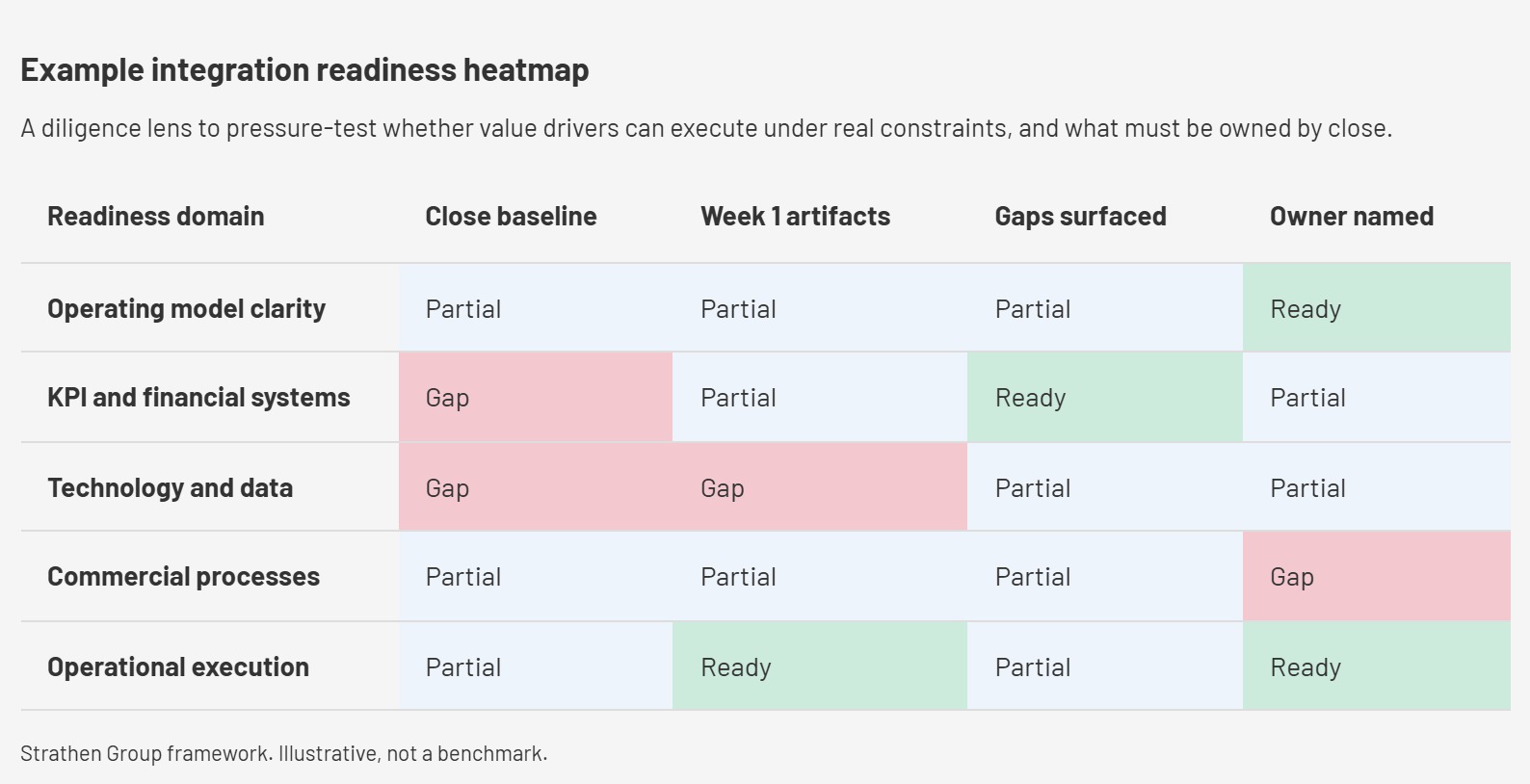
Integration readiness is not a vibe. It is a set of capabilities and artifacts. Pressure-test: operating model clarity (decision rights, escalation, accountability), financial and KPI systems (definitions, traceability, cadence), technology and data (system landscape, integration points, master data health), commercial processes (pipeline hygiene, renewal motion, pricing governance), and operational execution (fulfilment, service, quality control, vendor management). The output is a readiness heatmap that informs sequencing and the first 100 days plan.
IV. What does a credible first 100 days plan look like, and who owns it?
Diligence should end with a runnable plan, not a set of observations. That means a first-wave initiative pipeline linked to value drivers, each with an owner, milestones, dependencies, and decision rights. It also means naming what must be stabilised before chasing uplift. If leaders cannot name top initiatives, owners, and a weekly cadence by close, they are deferring the hard work into the most chaotic period.
Great diligence produces a plan, not a binder.
How Strathen Group can help:
- Deal Pilot.
Value Driver and Integration Readiness Sprint (2–3 weeks). We run a deal-specific diligence lens that pressure-tests 3–5 value drivers against real operating constraints and produces an integration readiness view leaders can act on before close. Deliverables include value driver test cards, a constraints and prerequisites map, an integration readiness heatmap, and a clean first 100 days plan tied to owners, dependencies, and a weekly cadence.
- Build In-House Capability.
Diligence-to-Integration Operating System (6–8 weeks). After the pilot, we codify the method into a repeatable approach your team can run without outside support. Deliverables include a diligence playbook, standard templates, a deal gating and red-team cadence, and a train-the-trainer package for Corp Dev and Portfolio Operations.
- Deal Desk Support.
For the next 1–2 deals, we provide light-touch coaching to calibrate the lens, challenge assumptions, and keep the operating system consistent across transactions.
If you want diligence to drive a clear go or no-go decision and exit close with a runnable first 100 days plan, Strathen Group can help.