First 100 days roadmap to translate the deal thesis into execution

Value creation fails when the thesis stays conceptual. Leaders need a practical plan, clear owners, and a governance cadence management teams can run from day one.
The question behind this piece
Most deal theses are directionally right and operationally incomplete. They describe what value should be created, but not how it will be created, by whom, in what sequence, with what measures, and with what tradeoffs. Post-close, management teams inherit expectations while the organization continues to run the business. How do you translate the deal thesis into an operating system for the first 100 days that creates momentum, protects credibility, and sets up sustained value creation?
Why this matters now
The bar for value creation discipline has increased. Capital is more selective, timelines feel tighter, and tolerance for “we will get to it in quarter two” is lower. At the same time, portfolio company teams are absorbing change while managing real operating volatility across customers, labor, supply chain, and systems.
Old approaches fail because they treat the first 100 days as either a rush of disconnected actions or a period of analysis that delays execution. The right model is neither. Leaders need a focused set of initiatives tied to the thesis, governed with a cadence that drives decisions and removes blockers quickly.
A thesis that cannot be run as a weekly operating plan is not yet a thesis.
Our perspective
A first 100 days operating system has one job. Convert thesis into execution discipline without overwhelming the business. The core is simple: a narrow initiative pipeline, clear decision rights, a KPI tree, and a weekly rhythm.
Translate the thesis into a small number of value themes and hypotheses
Rewrite the investment thesis into 3–5 value themes the management team can own. Each theme should include a hypothesis that can be tested inside 100 days. Examples include pricing and mix discipline, cost-to-serve reduction through operating model changes, focused GTM acceleration, or tighter working capital execution. This step matters because it reduces interpretation. If each leader carries a different thesis, execution drifts immediately.
Build a focused initiative pipeline with clear entry criteria
Most plans fail because they include too much. The first 100 days should not be a full transformation. It should be a prioritized pipeline where each initiative has a clear outcome, an owner, a baseline, 30/60/90-day milestones, and defined dependencies. Use simple entry criteria: ties directly to a thesis theme, can start within 30 days, and can show evidence of traction within 100 days. If not, it belongs in the next wave.
Write initiative charters that force operational clarity
Charters are where execution becomes real. Keep them short and runnable: objective, scope boundaries, owner, supporting roles, milestones, key risks, required decisions, and success metrics. Include what will not be done to protect focus. Charters also reduce “drive-by initiatives” by giving the team one stable reference point when priorities get noisy.
Establish decision rights and escalation before the first steering call
First 100 days efforts often fail at the seams: who can approve spend, change pricing, restructure a function, renegotiate vendor terms, or pause low-value work. If decision rights are unclear, leaders delay or escalate informally, and the cadence becomes theater. Define decision rights early across sponsor, deal team, board, and management. Then define escalation triggers: what requires immediate review, and what stays within the team.
Build a KPI tree that connects to the thesis and can be run weekly
A common failure mode is too many metrics, or the wrong metrics. The KPI tree should connect thesis themes to leading indicators and operational drivers, with baseline definitions, reporting frequency, and owners. Most importantly, the KPI tree must support weekly decisions. If a metric only moves quarterly, it should not dominate weekly governance.
Run a governance rhythm that removes blockers and protects accountability
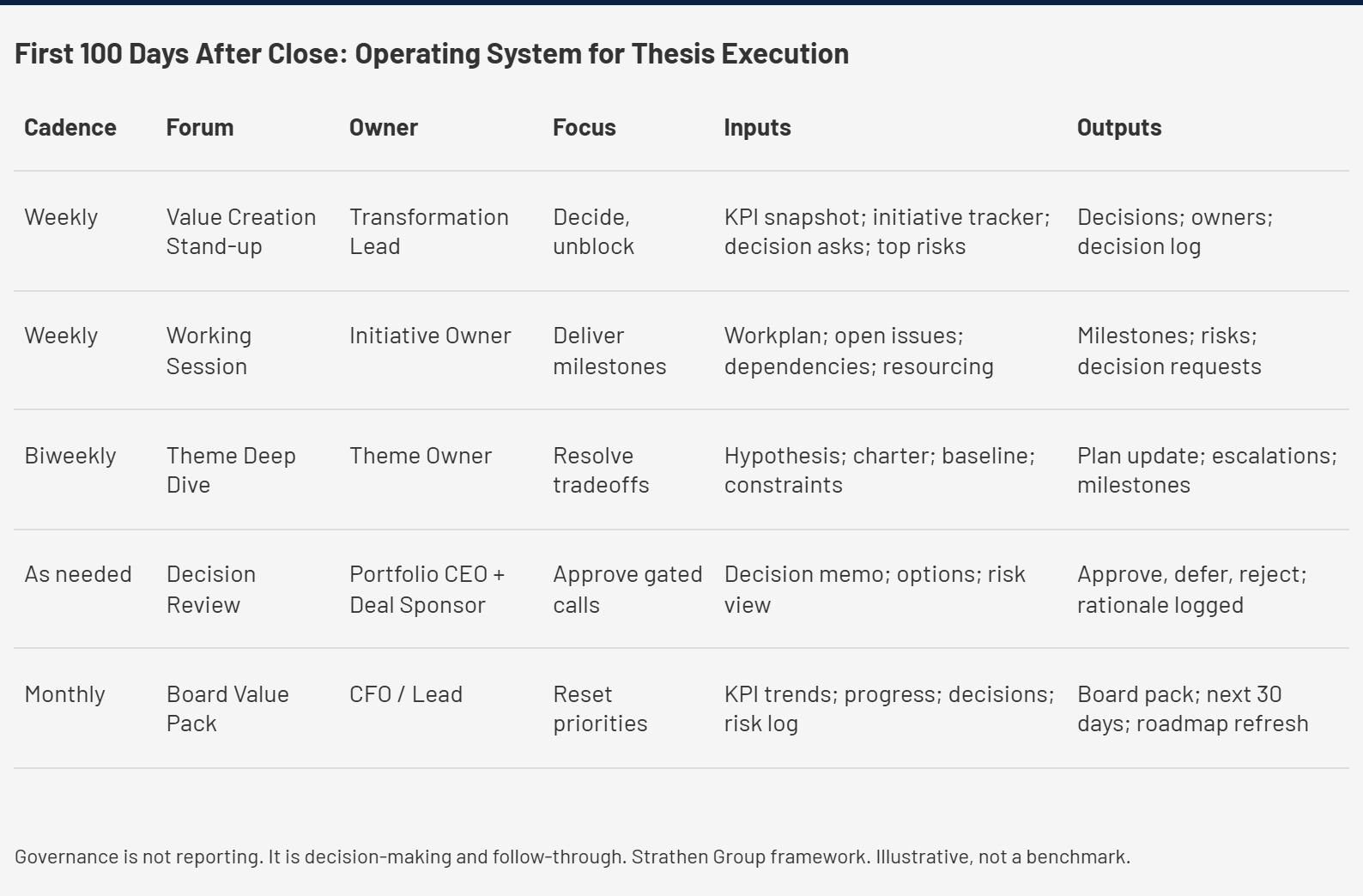
Keep cadence lightweight but real. A practical model includes a weekly value creation stand-up (status, decisions needed, blockers), a biweekly deep dive (one theme per session), a decision log and risk log, and a monthly board-ready pack that ties progress back to the thesis. Governance is not reporting. Governance is decision-making and follow-through.
The first 100 days is where credibility is built. After that, “execution” becomes a slogan.
How Strathen Group can help:
Playbook + Templates: First 100 Days Operating System (3–4 weeks).
We translate the deal thesis into a runnable first 100 days operating plan, including a focused initiative pipeline, short initiative charters, a thesis-linked KPI tree, and clear decision rights with escalation triggers. We can also build the weekly governance rhythm and board-ready pack, so the team can make decisions, remove blockers, and show credible momentum from week one. If you are entering a close, recap, or the first 90 days post-close, contact Strathen Group.