Alberta’s data centre moment needs a delivery plan

Alberta has a real opportunity to attract data centre investment, but demand is no longer the constraint. Power, interconnection certainty, land readiness, permitting throughput, and credible partnership structures now decide who wins.
The question behind this piece
Meta’s announcement answered the attraction question.
It did not settle the execution question.
What must Alberta learn from the first major project so that future investments can move from announcement to operation with greater certainty, clearer ownership, and fewer extraordinary interventions?
Why this matters now
In July 2026, Meta announced that it is breaking ground on its first Canadian data centre in Sturgeon County. The planned campus is expected to provide 1GW of capacity and represents an investment of more than CAD $13 billion. Meta says the project will support approximately 3,000 workers at the peak of construction and more than 300 operational jobs once complete.
The announcement confirms that Alberta can compete for global AI infrastructure investment.
It also demonstrates how many systems must work together to deliver a project of this scale.
Meta says it will fully fund the new generation and grid infrastructure required for the site. The company also plans approximately CAD $60 million in local infrastructure improvements and a closed-loop, liquid-cooled system using dry cooling, with no operational water use for the cooling system. These are not secondary project details. They show that data-centre delivery crosses power, grid infrastructure, municipal services, water stewardship, construction, community relationships, and long-term operations.
Alberta has already established a strategic foundation. The province’s AI Data Centres Strategy is organized around power capacity, sustainable cooling, and economic growth. It also identifies regulatory modernization, municipal collaboration, Indigenous partnerships, and an investor concierge program as priorities.
The province also acknowledges that individual projects may require approvals and coordination involving the Alberta Utilities Commission, the Alberta Electric System Operator, municipalities, Indigenous consultation, environmental requirements, natural gas connections, water, broadband, and other project-specific considerations.
Winning a project is an investment-attraction success.
Delivering it is a multi-year coordination challenge.
The next advantage is not demand. It is repeatable delivery.
Our perspective
One landmark project does not create a delivery system.
It tests one.
The long-term value of Alberta’s position will not be measured only by the first major campus. It will be measured by whether the province can deliver the second, fifth, and tenth project with clearer pathways, credible commitments, and less reliance on extraordinary coordination.
The leadership challenge is not to replace the technical expertise already present across government, regulators, utilities, municipalities, industry, and communities.
It is to bring those perspectives together around a coherent set of decisions.
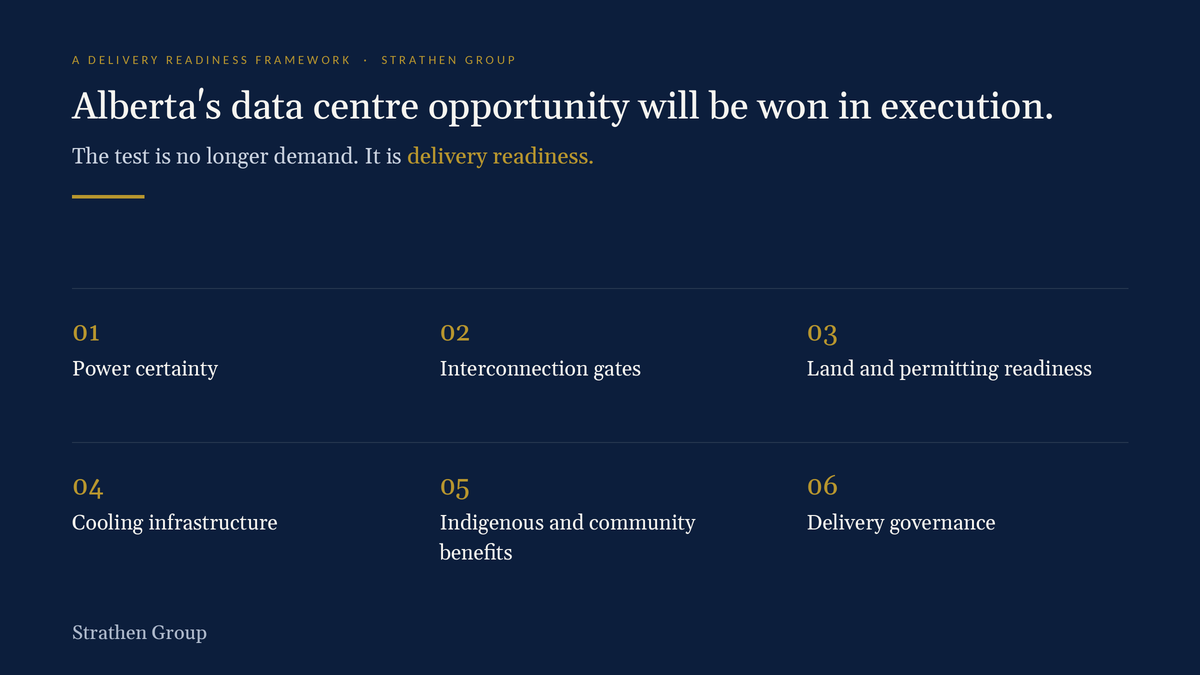
Six questions matter.
- What does power certainty mean at each stage?
“Power available” can mean different things to different stakeholders. Leaders need a shared understanding of what has been studied, approved, contracted, funded, and scheduled, and what remains an assumption. The executive question is: What evidence supports the project’s power pathway today, and what decisions remain unresolved?
- What evidence moves a project from interest to credible commitment?
A large pipeline of interested investors is not the same as a pipeline of executable projects. Projects will differ in capital readiness, land control, operating model, power strategy, development schedule, and commercial commitment. The executive question is: What evidence should leadership expect before scarce attention, infrastructure capacity, or public resources are committed?
- Where does the approvals pathway become difficult to navigate?
Data-centre projects intersect with multiple organizations, jurisdictions, and approval processes. The challenge is not necessarily the existence of regulation. It is whether project sponsors and decision-makers understand the sequence, dependencies, ownership, and escalation path. The executive question is: Where are decisions likely to wait, and who has the authority to resolve the issue?
- Which supporting infrastructure commitments must be understood early?
Power is central, but it is not the only infrastructure consideration. Land servicing, roads, telecommunications, natural gas, emergency services, construction capacity, water and wastewater requirements, and municipal infrastructure may all affect delivery. The executive question is: Which commitments are required, who funds them, and when must each decision be made?
- How will Indigenous and community benefits be defined and followed through?
Major projects create expectations around employment, procurement, infrastructure, local investment, Indigenous participation, and community benefit. Credibility depends on the difference between an aspiration and a governed commitment. The executive question is: What has been promised, how will it be measured, and who remains accountable after the announcement?
- Who owns the integrated delivery picture?
Each organization may understand its own responsibilities while no one has a complete view of the program. That creates the risk that dependencies remain invisible until they affect schedule, cost, or stakeholder confidence. The executive question is: Who brings the full picture together, identifies unresolved decisions, and escalates issues before they become delays?
What Alberta should learn from the first project
The Meta investment is an important validation of Alberta’s strategy. The next step is to learn deliberately from delivery. That means capturing:
- Which decisions took the longest.
- Which assumptions changed.
- Which stakeholder interfaces worked well.
- Where ownership was unclear.
- Which commitments require long-term follow-through.
- What should become standard before the next major proposal arrives.
The objective is not a perfectly centralized process. It is a more legible, evidence-based, and repeatable one.
Where Strathen Group can contribute
Strathen Group’s role is at the leadership, strategy, and governance layer.
We can help leadership teams:
- Structure executive conversations around the decisions that matter.
- Map cross-organizational dependencies and unresolved assumptions.
- Clarify ownership, escalation paths, and decision forums.
- Pressure-test whether an execution narrative is supported by evidence.
- Facilitate alignment between leaders and the relevant technical specialists.
Technical engineering, grid modelling, regulatory interpretation, environmental assessment, municipal planning, and Indigenous consultation remain with the appropriate experts. Our value is helping leadership teams turn those specialist inputs into a coherent decision and execution conversation.
If your organization is evaluating the implications of Alberta’s data-centre growth, we would welcome an informed discussion.