Agentic AI for permits and approvals

How a supervised permitting co-pilot can speed decisions without cutting corners.
The question behind this piece
Permits and approvals are where citizens and businesses feel the state most directly. A restaurant license. A building permit. A zoning variance. A nonprofit registration. Too many of these journeys are slow, opaque, and dependent on individual reviewers. Two similar applications can receive different outcomes because the process is inconsistent, the criteria are scattered, or the evidence is hard to assemble.
This piece asks one question: can a supervised agentic system sit beside case officers, apply policy consistently, and draft defensible recommendations, without becoming a black box that weakens accountability?
Why this matters now
Pressure is rising on three fronts.
First, demand keeps climbing. Growing cities, new businesses, and more complex rules increase volume, while staffing rarely keeps pace. Backlogs become operational risks and political liabilities.
Second, user expectations have shifted. Citizens and businesses expect status transparency, clear requirements, and predictable timelines. A months-long wait with little communication now reads as dysfunction, not bureaucracy.
Third, scrutiny is tighter. Courts, oversight bodies, and the public increasingly expect decisions to be explainable, consistent, and free from unlawful bias. One high-profile reversal can erode trust across the whole system.
In the last 12 to 24 months, the technical frontier has moved. Modern language models can read long applications, extract issues, and synthesize guidance in plain language. Retrieval methods can anchor recommendations in the specific policy clauses and precedents that support them. The limiting factor is no longer “can the model read,” but “can the agency express criteria clearly, control access, and prove how decisions were formed.”
In permitting, AI only helps if it makes decisions more transparent, not less.
Our perspective
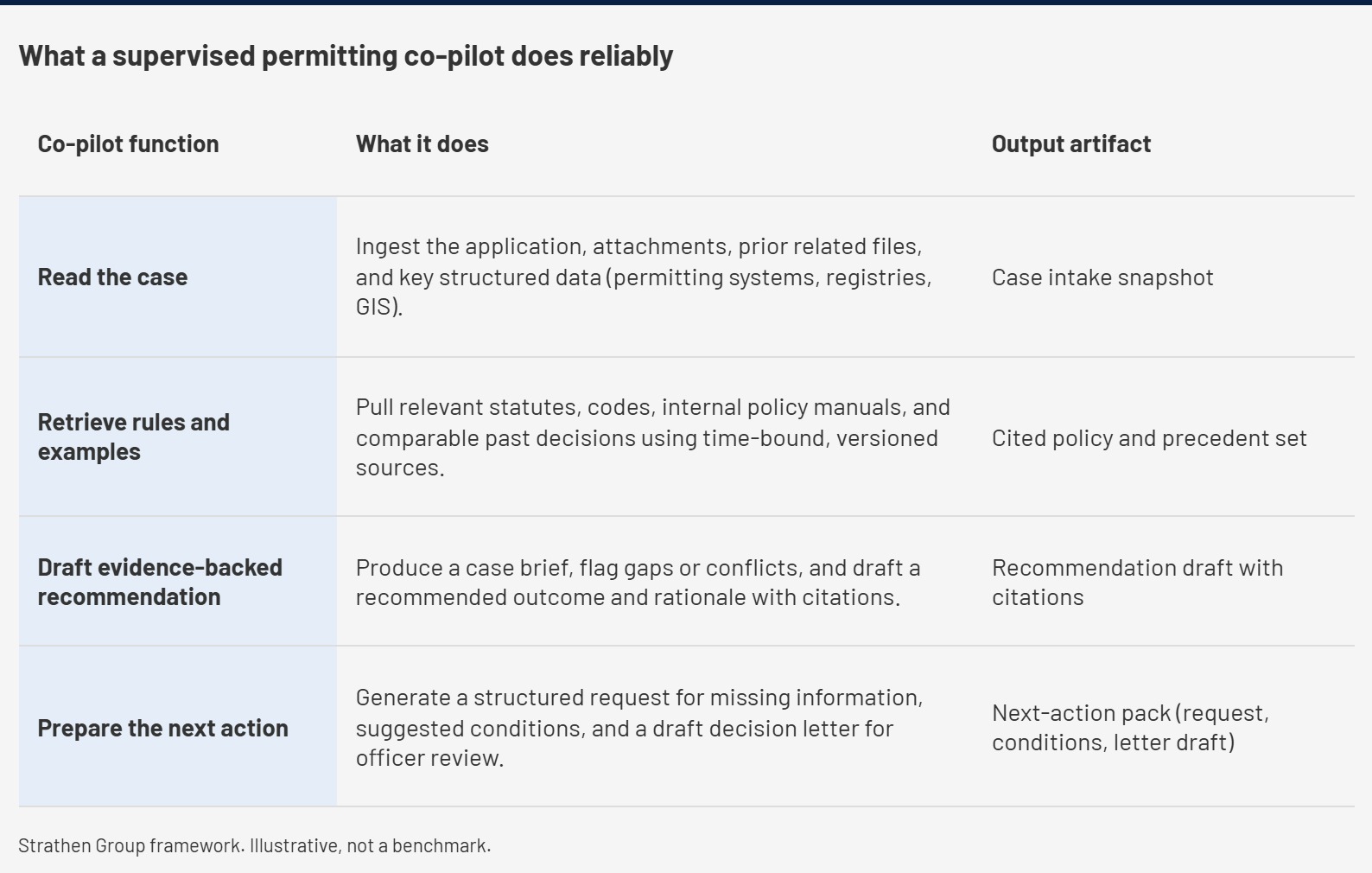
The right pattern is a supervised permitting co-pilot, not an automated approval engine. In this model, the human officer remains the decision-maker. The co-pilot raises throughput and consistency by doing the heavy lifting that slows teams down: reading, retrieving, checking, and drafting.
A well-designed co-pilot does four things reliably.
This approach works best when criteria are written down and reasonably stable, there is a history of comparable decisions, and leadership is willing to standardize templates and checklists. It struggles when policy is unclear or contested, source data is unreliable, or the real goal is to replace staff rather than improve decision quality.
Do not automate the decision. Standardize the decision, then augment it.
We can help. Strathen Group can run a focused working session with your operations, legal, and digital leaders to pressure-test the use case and define a safe path forward.
You will leave with three concrete outputs:
- Use-case selection and scope: the permit type to start with, the boundaries, and success measures.
- Decision criteria map: the checklist, evidence requirements, and where discretion must remain human.
- Governance guardrails: audit logging, escalation rules, access controls, and a clear “stop line” for automation.
If you are a leader in the public sector and are looking to optimize your organization's permit approval process, let's discuss how we can reduce permitting timelines while strengthening trust and defensibility.