

Building a repeatable growth engine for a $41M payments portfolio

A global payments provider clarified where to win and equipped regional teams with sharper narratives, repeatable sales plays, and a portfolio-level growth plan they could execute consistently.
Starting point
A global merchant acquirer managed a $41M payments portfolio across financial services and healthcare. Buyers ranged from banks and insurers to remittance firms, trading platforms, digital health companies, and large provider networks. Each segment prioritized different outcomes, including card-not-present performance, conversion under strong customer authentication, fraud and dispute outcomes, cost of acceptance, and cross-border FX and settlement experience.
Regulatory and risk constraints amplified the challenge. 3DS and SCA practices under PSD2, privacy requirements, and healthcare compliance shaped what could be sold and how solutions could be deployed by market. Teams in APAC, EMEA, and North America saw opportunity, but leadership lacked a shared view of where to focus, what to lead with, and how to track progress against the 10% year-on-year mandate. Pursuits fragmented, messaging drifted, and product feedback arrived unevenly.
Approach
At the time, Bhuvan Maingi, now at Strathen Group, was part of the internal team leading vertical growth strategy for priority financial services segments. The work began by forcing clear choices on where to play and how to win. The team defined ideal customer profiles and buyer personas, quantified addressable spend, mapped target accounts, and assessed competitive positioning. This produced a single, defensible view of priority segments and the firm’s right to win.
The strategy was translated into practical value propositions anchored in buyer outcomes and levers the firm could influence, including authorization performance, conversion under SCA, fraud outcomes, cost of acceptance, and payout and settlement experience. Positioning was tailored by region to reflect differences in payment method mix, regulatory expectations, and corridor economics.
GTM execution followed through repeatable pursuit plays. The team built target lists and tiered pursuits by segment and account type, clarifying who to call on, what to lead with, and how to sequence conversations. Conference presence and speaker narratives were aligned so commercial leaders showed up with one consistent story on authorization performance, acceptance economics, and alternative payment methods. Partner motions with key ISVs, PSPs, and gateways were mapped by region, including where to co-sell and where to integrate first.
Sales enablement made the strategy usable at the front line. Playbooks provided talk tracks, objection handling, and competitive framing. Commercial math templates helped sellers quantify value using basis points of authorization uplift and reductions in cost of acceptance, translating those into approved volume and revenue impact. These tools strengthened bids and RFP responses across merchant acquiring and payment orchestration.
The vertical team also served as a structured voice of the customer into product. Requirements were distilled into clear asks across alternative payment methods, localization, risk and compliance features, and reporting. This shaped the roadmap and clarified where partnerships or M&A would close gaps faster than building in-house. Leadership was supported with disciplined diligence, including financial models and competitive assessments.
A light operating rhythm kept execution aligned across regions. Monthly reviews assessed pipeline health, coverage versus targets, and win-loss themes. Quarterly regional reviews aligned APAC, EMEA, and North America on performance and pursuit lessons. Standard QBR templates and scorecards ensured account teams reported consistently on pipeline, authorization performance, cost of acceptance, chargebacks, APM attach, and regional mix.
A portfolio-level growth plan replaced scattered pursuits with one set of priorities, one sales story, and consistent commercial math across regions.
Outcome
The portfolio moved from a loose set of opportunities to a clearer vertical growth engine. Leaders and regions gained a defensible view of where to focus, which segments to treat as strategic, and how to position the firm’s strengths by segment.
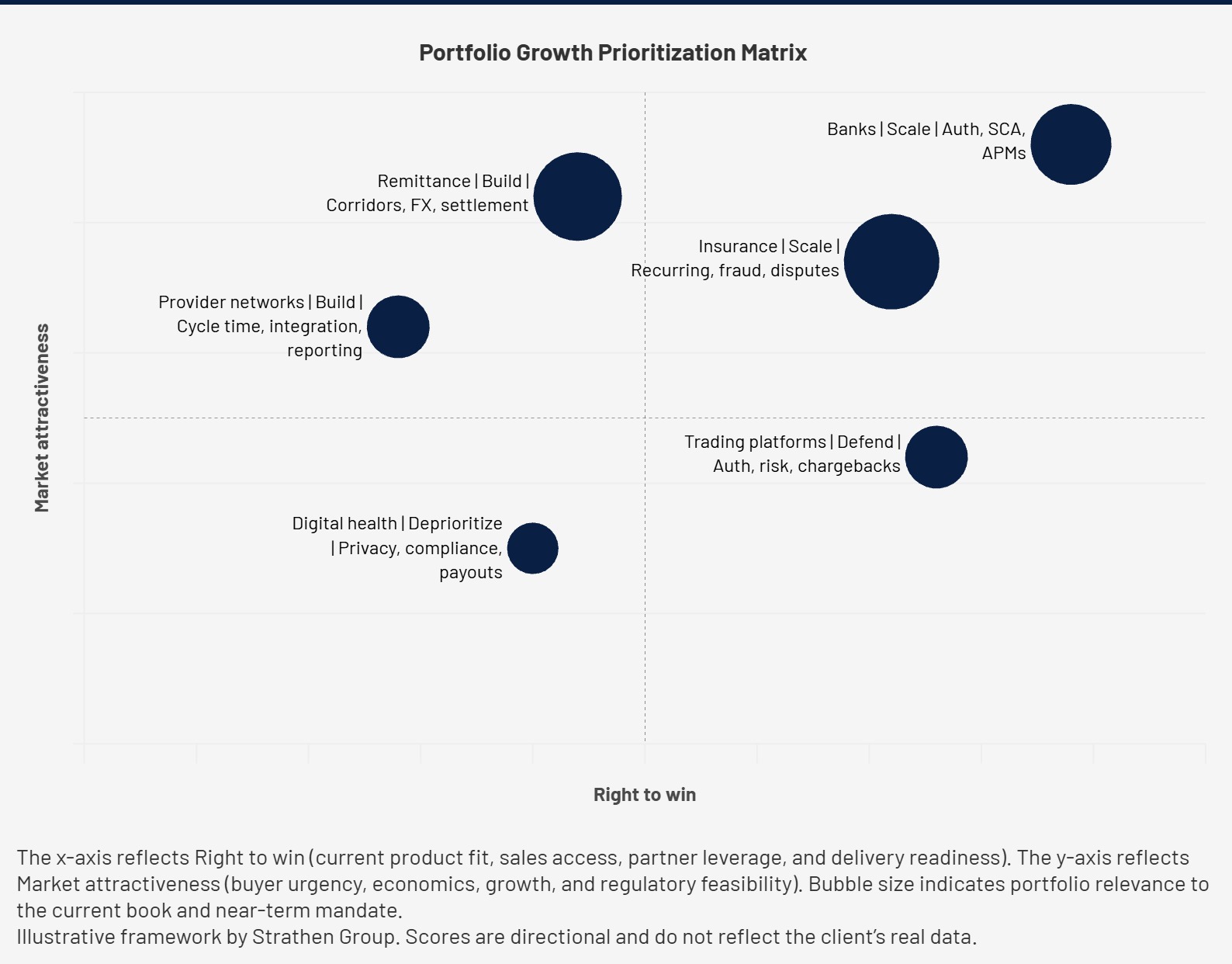
Deal quality and velocity improved. Sellers ran tighter conversations on right to win, anchored in clear stories on authorization performance, acceptance economics, and alternative payments tailored to local market needs. The link between market demand and the product roadmap tightened as structured input from vertical teams replaced ad hoc requests. Partner and investment discussions became more disciplined, focused on what would accelerate the plan.
Leadership could track progress against the growth mandate on the US$41M book using a consistent set of metrics and reviews across APAC, EMEA, and North America, including coverage versus target, stage conversion, time to close, and win rate in priority pursuits.
Growth becomes repeatable when strategy, sales, and product run off one set of priorities and one view of value.
Today, this work shapes how Strathen Group approaches growth in payments: clarify right to win, codify commercial math, and connect both to GTM and product decisions leaders can run.



