A tiered pursuit engine for embedded finance deals

The client built a tiered, end-to-end sales enablement system so sellers could qualify harder, pitch faster, and run executive-grade pursuits with consistent narratives, commercials, and ownership clarity.
Starting point
Demand for embedded finance was rising across industries, but selling it well was difficult. Deals spanned card issuing, money movement, wallets, and bank-grade questions around compliance ownership. Prospects asked executive-level questions early: economics, operating model, risk boundaries, and what it would take to implement in phases.
Inside the client’s go-to-market motion, selling was largely ad hoc. Sellers relied on individual knowledge, one-off decks, and inconsistent discovery. Pipeline often accumulated names without a shared scoring discipline, making it hard to focus time on the opportunities most likely to qualify. Once a prospect engaged, each pursuit required rebuilding narratives, commercials, FAQs, and ownership views from scratch. The result was predictable: slower time-to-proposal, uneven executive credibility, and heavy rework when the right stakeholders joined.
The client needed a system that made embedded finance easier to sell at scale without diluting rigor. That meant standardizing what could be standardized, while preserving the ability to go bespoke when the opportunity justified it.
Approach
The client engaged a go-to-market team that included Bhuvan Maingi, now Managing Partner of Strathen Group, to build a repeatable pursuit engine for embedded finance. The work focused on three connected changes: qualify with discipline, pitch with reusable assets, and support strategic pursuits end to end.
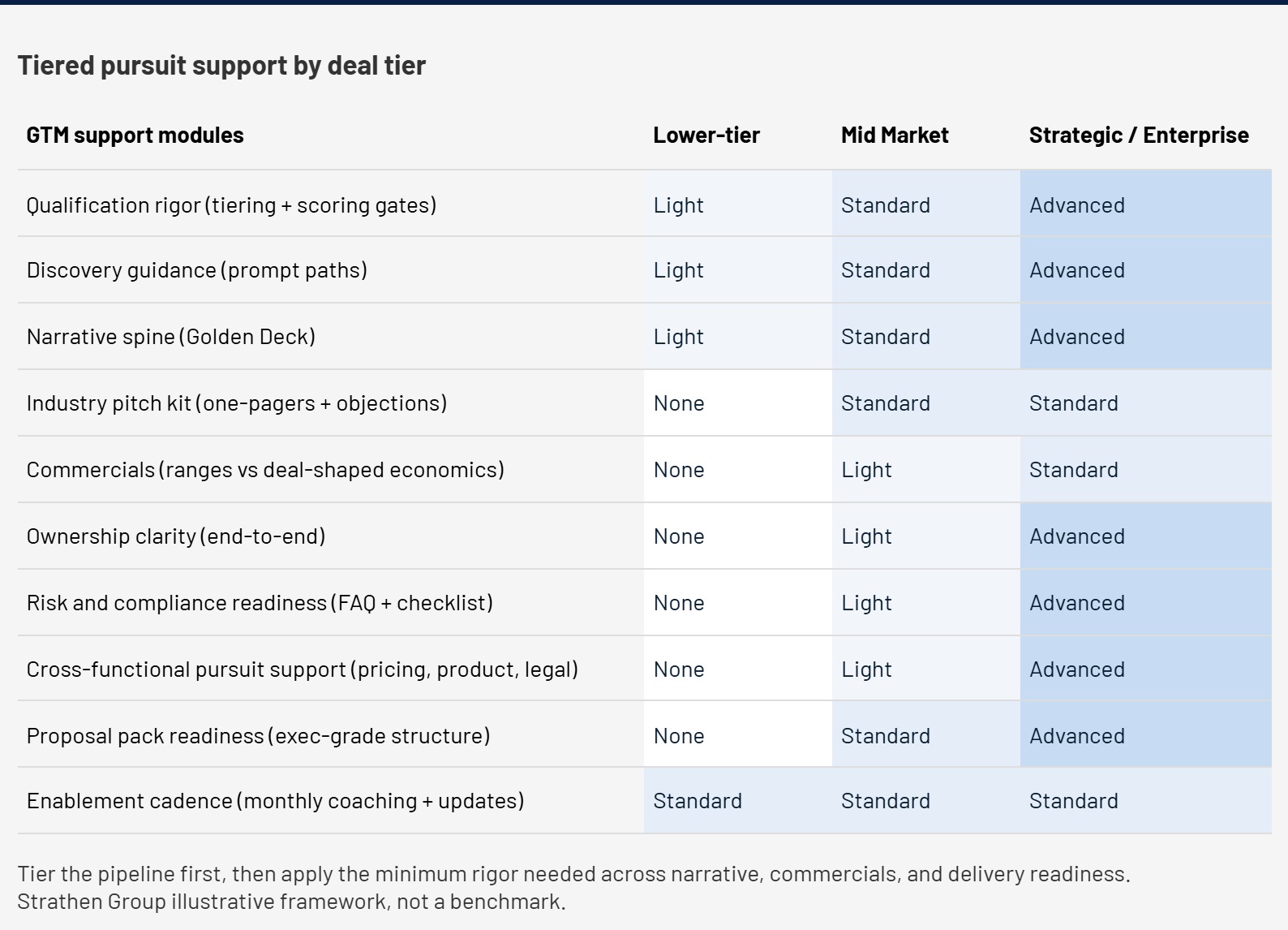
First, the team partnered with sales leadership to introduce pipeline tiering and scoring. Opportunities were segmented into tiers, and a scoring methodology created objective guardrails. This shifted the operating cadence. Sellers stopped treating pipeline as a list and started treating it as a ranked set of pursuits, each with an appropriate level of enablement support.
Second, the team built standardized collateral for mid-market and lower-tier pursuits. The goal was speed and consistency without sacrificing substance. This included a core pitch narrative, high-level commercials appropriate for early-stage conversations, product knowledge modules, and FAQs that sellers could use without assembling new decks every time. To make this relevant by buyer context, the team also produced industry-specific one-pagers that summarized key challenges, common objections, and how embedded finance mapped to outcomes for each target industry.
Third, for strategic and enterprise-tier deals, the team supported sellers with well-researched, bespoke pitch decks. These were designed to answer the questions senior stakeholders predictably ask: why embedded finance, why now, how the operating model works in practice, what the economics could look like, and how to phase implementation credibly.
At the center of the system was a Golden Deck, a master narrative of roughly 20 slides that anchored the embedded finance story: company context, market framing, the embedded finance thesis, and the core platform capabilities. It included modular inserts so the same deck could flex by industry, product mix, commercials, demos, and case studies. This created a single source of truth that sellers could trust and leadership could maintain.
The system also reflected how embedded finance deals actually move. Early-stage conversations benefited from clear, high-level commercials and crisp positioning. Larger, higher-stakes pursuits required deeper collaboration with commercial and pricing teams to shape deal-specific economics. The pursuit engine created the handoffs and expectations so sellers knew when to stay within standard guardrails and when to pull in specialist support.
Enablement was delivered as an operating rhythm, not a one-time content drop. Each month, a new industry campaign launched with fresh collateral and a coaching session for the entire sales team. This reinforced consistent talk tracks, created shared muscle memory, and helped sellers build confidence in how to run discovery, handle objections, and move to proposals.
The shift was simple: score and tier the pipeline, then match every pursuit with the right collateral and support.
Outcome
The client moved from ad hoc selling to a repeatable embedded finance pursuit motion. Sellers had a coherent storyline to lead with, industry context to anchor the conversation, and usable collateral that reduced the time required to move from discovery to a credible pitch. Executive discussions became easier to navigate because the narrative, commercials, and implementation logic were no longer rebuilt for every meeting.
The tiered scoring approach helped the organization focus energy where it mattered. With objective guardrails, the team could prioritize high-likelihood opportunities and adjust the level of support based on deal tier. That improved internal alignment and reduced the common failure mode of over-investing in low-quality pursuits while under-serving strategic opportunities.
For higher-tier pursuits, the Golden Deck and modular inserts increased win-readiness without sacrificing rigor. Instead of assembling bespoke decks from scratch, sellers started from an executive-grade spine and went deep only where the account context demanded it. This also improved cross-functional coordination, because product, legal, pricing, and engineering teams could align to a consistent narrative and set of assumptions.
Sales enablement becomes a growth lever when it is a system, not a folder of slides.
At Strathen Group, we build pursuit engines that combine qualification discipline with reusable narrative spines and the minimum set of artifacts required to sell and deliver with confidence.