

Unblocking 40% capacity for FP&A team with operations across four countries

Process mapping and targeted automation shortened the month-end close, cut manual reconciliations, and shifted finance time from administration to higher-value analysis for a European offshore energy producer.
Starting point
The client's finance month-end had grown into a 15-business-day marathon. FP&A teams based in the UK, Ireland, the Netherlands, and Denmark followed different practices and processes. Activities were duplicated, reconciliations were heavily manual, and local workarounds had accumulated over time.
Most of the teams' capacity in the first three weeks of every month went into closing the books. Very little time remained for analysis, forecasting, or partnering with the business. Leadership knew the process was too slow and too manual, but did not have a clear picture of what actually happened, when, by whom, and with what value.
The CFO and Financial Controller set four objectives: shorten close to single digits, remove work that did not add value, automate high-friction steps, and quantify both time and cost savings in a roadmap they could own.
Approach
Finance leadership brought in an external strategy and operations team to run a rapid diagnostic and design practical solutions. Bhuvan Maingi, now Managing Partner at Strathen Group, served as lead strategy consultant on the engagement.
The work began with a structured diagnostic. He interviewed twenty-eight people across all four geographies, capturing how month-end actually worked rather than how it was documented. Using SIPOC methodology and detailed process maps, he logged every activity involved in closing the books and consolidated them into a single one-page month-end map. In total, he catalogued 267 activities and logged 106 issues and observations.
From there, he synthesized opportunities. Each pain point was translated into a potential change, with estimates of effort and benefit. Forty opportunities were identified and grouped into themes: reconciliations, reporting, accruals, time-writing, workflow, joint venture processes, and clearing and recharges. An effort-versus-benefit lens helped the CFO and Financial Controller select a focused set of eight solutions that could materially shift close time and cost.
Solution design went beyond high-level ideas. For each of the eight priority solutions, he drafted a solution statement describing the change, the teams affected, the process impacts, and quantified time savings. Examples included:
- Reconciliations: streamline the reconciliation portfolio and automate matching in a dedicated tool so people spend time on exceptions rather than manual ticking and tying.
- Reporting: rationalize reporting packs, remove unused outputs, define a clear reporting hierarchy, and build toward a finance data warehouse to automate data manipulation.
- Accruals: remove non-material accruals, use SAP plan-based functionality where possible, and automate large manual calculations.
- Time-writing: standardize tools and processes across regions and automate SAP loading and reconciliation to cut rework.
- Workflow and orchestration: implement a single month-end workflow or orchestration tool to replace spreadsheets and email trails for status, approvals, and sign-offs.
- Clearing and recharges: redesign processes to minimize pooling and apply rules-based allocation and automated clearing.
To anchor the business case, he built a time and cost model. The baseline captured 1,085 hours of effort per month-end cycle, with 847 hours tied directly to activities addressed by the eight solutions. Of those, 528 hours per cycle were identified for removal, automation, or material reduction. Using a fully-loaded cost assumption, this translated into £281,000 in annual savings, alongside the qualitative benefit of significantly more time for analysis and business partnering.
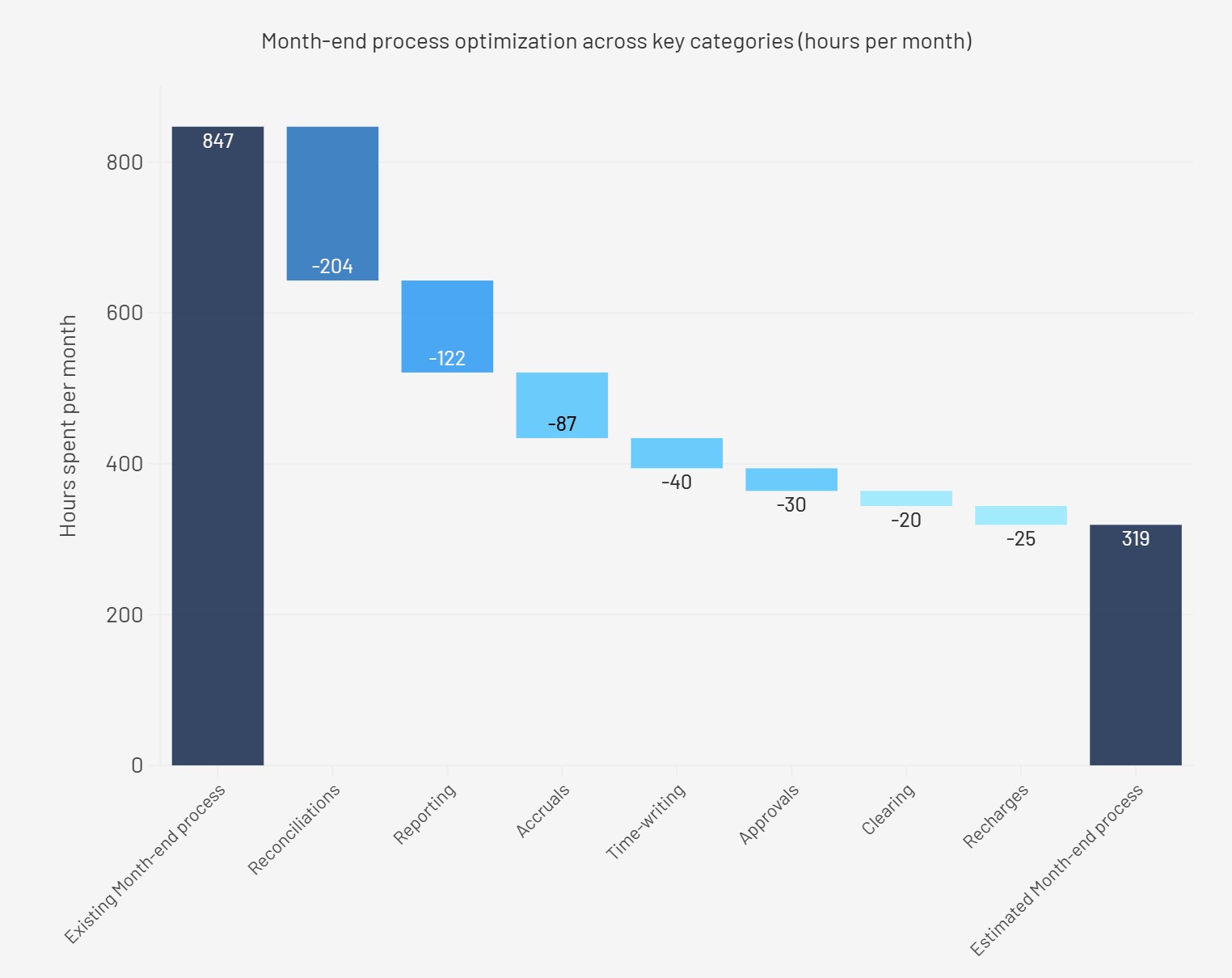
Finally, he worked with finance leadership to design a new operating rhythm for a 9-day close. This included clearer cut-off dates, hand-offs, and controls; alignment across the four countries on a minimum standard month-end; and a roadmap for implementing the priority solutions without disrupting business as usual.
Instead of pushing teams to work faster, leadership asked for a first principles view of the work, then cut and automated what did not need to be done by people in the first place.
Outcome
The engagement gave the CFO and Financial Controller something they had not previously had: a transparent, quantified view of month-end across four countries, and a focused set of solutions with clear ownership, sequencing, and expected impact.
For finance teams, the work reset expectations about their role. Removing non-material accruals, automating reconciliations and data manipulation, and introducing a single workflow view freed up capacity that could be redirected toward analysis, forecasting, and partnering with the business on decisions rather than just reporting them.
The finance month-end optimization became a reference point for broader operational excellence efforts within the organization. The discipline of mapping work end to end, prioritizing a small number of high-impact solutions, and tying each one to a clear operating rhythm has since shaped how similar capacity problems are approached across other functions.
For finance leaders, the shift was treating month-end as a designed service with a target cycle time, not as a fixed routine that had to be endured the same way every month.



